
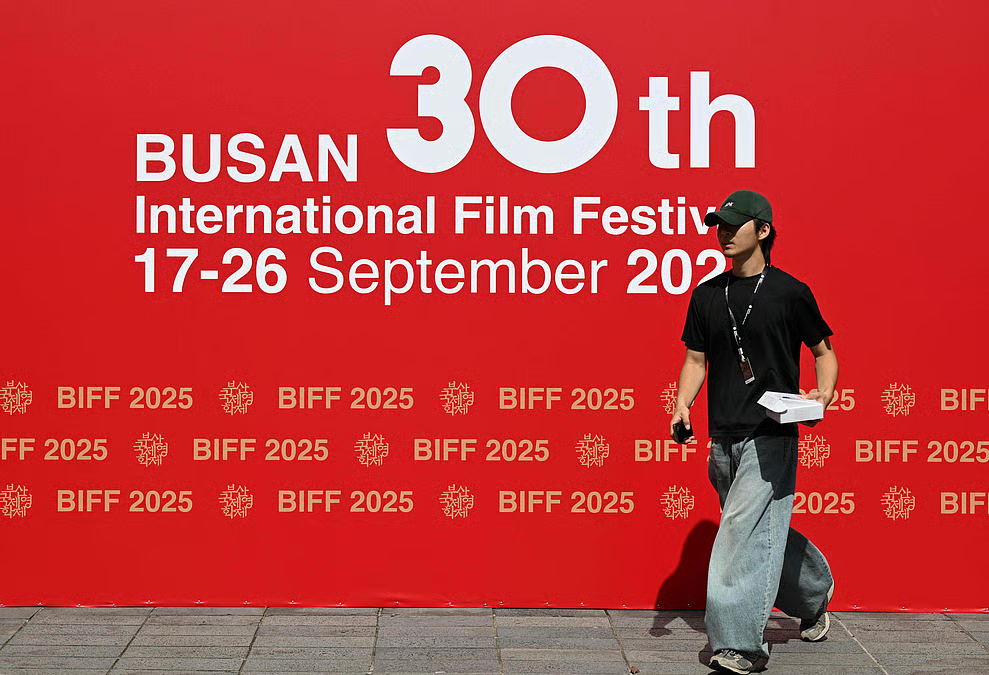
Showcased in Busan film competition
The Busan International Film Festival will, for the first time, have a complete slate of films competing to highlight “progressive” and “humane” regional cinema, the jury said here on Thursday.
Asia’s largest film festival gets underway this year with a “historic” competition, including 14 titles, four from South Korea. In previous years, it has only held a few, small-scale competitions.
The Asian feature jury, comprising seven members led by South Korea’s Na Hong-jin (the country’s director) and including local directors and actors, will choose the winners.
The 11 entries, six of which are by women filmmakers and five of which are first features, run the gamut from newcomers to seasoned hands, with subjects including teenage pregnancy, a plague-like disease, media censorship, and domestic violence.
The victor will play as the fest’s closer.
“The world itself is going through so many crises,” said Indian actress-director and jury member Nandita Das to reporters on Thursday.
“I hope we will select movies that are progressive, humane, and bring the world closer.
He was “hungry for Asian sensibilities,” his fellow member and the director of “Pachinko,” Kogonada, said.
“There’s a bit of flavour to, I guess, Asian cinema that might feel maybe slightly different and unique,” he added.
Security stands guard near a barricade ahead of the opening ceremony of the 30th Busan International Film Festival (BIFF) at the Busan Cinema Centre in Busan on 17 September 2025. AFP
It has taken “about 30 years” for the festival to have the confidence to introduce a full competition,” organisers said in a statement.
“No festival that wants to have a competition section can with integrity do so, unless it can attract and showcase films that are genuinely up there with the best,” programme director Karen Park told AFP.
“We might not have had that confidence in the early years, but I think we do now.
Highlights include the directorial debut from Taiwanese star Shu Qi, “Girl,” a coming-of-age drama about an underage girl with abusive parents.
It also features the latest film from the acclaimed Sri Lankan director Vimukthi Jayasundara, “Spying Stars,” about a scientist confronting a sudden pandemic.
The roster of four South Korean entries includes Yoo Jae-in’s “En Route To,” about a high school girl who, after conducting an affair with her teacher in secret, gets pregnant.
Another is Lim Sun-ae’s “Seven O’clock Breakfast Club for the Broken-hearted,” which profiles a kind of support group of people who continue to reel from terrible romantic breakups.
Park added that the lineup toiled to empower female directors in a region where they’re in a “doubly vulnerable” position, as “there is a glass ceiling to shatter”.
The festival director Jung Han-seok said, “We should make it a work to ‘promote the judging from an Asian standpoint’.
“In essence, we wanted to build a strong platform where I can show off the strength of Asian cinema,” he told AFP.