
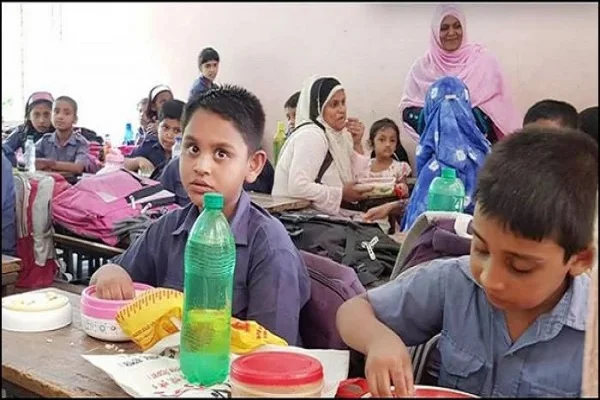
Bangladesh to introduce school meals for 31 lakh primary students
Bangladesh is poised to make a giant stride in basic education and child nutrition. This November, nearly 3.1 million primary schoolchildren in 165 upazilas (subdistricts) will start receiving daily nutritious meals under an expanded national school feeding programme, one of the country’s most ambitious efforts in recent years.
The announcement came from Abu Noor Md Shamsuzzaman, Director General of the Directorate of Primary Education (DPE), during an exclusive interview at his Mirpur office.
One Meal a Day, Five Days a Week
Students will start receiving a diversified mix of eggs, milk, bananas, bread, biscuits, and seasonal local fruit five days per week from Nov. 17.
“Our aim is clear,” Shamsuzzaman said. “To take students from being less attentive, participating less in class and not eating well to doing better and staying in school. A child, when nourished, is a motivated child.”
The programme uses poverty data from the Bangladesh Bureau of Statistics to ensure the initiative is rolled out in the most needed areas. Every upazila will be covered by at least one participating district. In Bandarban and Cox’s Bazar, all schools have also been incorporated, with the World Bank funding meals in 15 upazilas of these two districts. The government will finance the remaining 150 upazilas.
Countrywide Service Next Title Year
The scale is poised to grow at extraordinary speed. The remaining 349 upazilas would be included in the next fiscal year’s second phase, simultaneously with the full-scale implementation of the programme nationwide, benefiting around one crore primary students.
The expansion is one of the most significant school meal commitments in South Asia.
Boosting the Teaching Workforce
Beyond that, too, the DPE chief also spoke regarding teaching recruitment and career advancement:
The recruitment rules are being finalised, and we believe a call for applications will come out in November.
First grades of secondary education will be followed next by the much-awaited “10th-grade Head Teacher” programme.
The proposal to upgrade assistant teachers to Class 11 has already been sent to the Finance Ministry.
But further recruiting has been put on hold by a legal challenge over 32,000 acting head teachers.
“After resolving this issue, it will hopefully become easy for teachers to get promotions and new postings.”
Empowering Schools and Teachers
The DG also announced a few reforms to provide autonomy to schools and enhance infrastructure:
The head teacher’s expenditure limit is to be raised from 150000 to 300000 jointly by the pair of persons.
There are also significant infrastructure developments, including repairs to schools, construction of model school buildings, construction of boundary walls, and PTI (Primary Teachers’ Institutes) & URC (Upazila Resource Centres).
The objective is that no building will be in a dilapidated condition three to five years from now.
PDP-5, the following major development project, is scheduled to commence in July 2026.
Technology in the Classroom
Bangladesh’s elementary schools are also moving into a more digital age. The DPE is deploying 3,000 interactive flat panels in classrooms throughout the country.
‘Continuing concerns on cost, electricity and security notwithstanding, we are committed to taking digital learning resources to more than half of all schools within five years,” the DG said.
Stronger School Management
DPE is reforming the management of ad hoc school committees to effect better governance. There will be an educated, community-active president in the future presidents’ committee, rather than having one sitting in an interim position under the education officer’s control.
Hopkins has taken a step toward establishing a better and smarter generation.
The expanded school feeding programme is not just about nutrition; it is an investment in Bangladesh’s human capital. “With better nutrition, school leadership, and teacher support, as well as 21st-century learning tools, the DPE seeks to make schools countrywide a healthy, inclusive, and effective place for children to learn.
When those first meals are served this November, millions of children will not simply eat food; they will be served a brighter future with a better opportunity to gain experience, grow, and develop.