
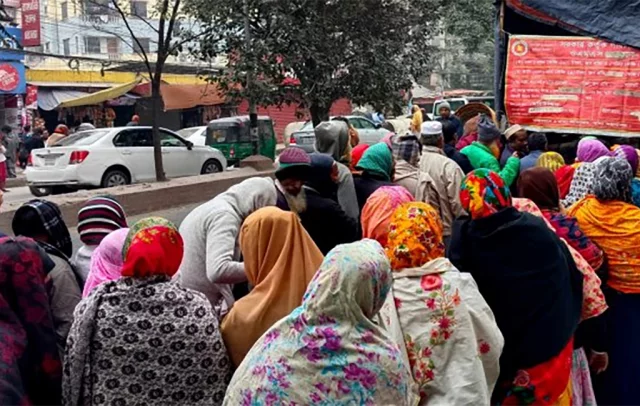
Why the seasons we know may vanish within a generation
Now Bangladesh may be on the cusp of transitioning to a new climatic phase, one in which winter is less a season than a memory. Meteorologists caution that the country’s familiar order of six clearly defined seasons is vanishing, giving way to longer and deadlier heat waves, more intense monsoons and a climate that changes too quickly for tens of millions of people to adjust.
Under a blistering summer sun, a mother squats beside her child and pours pond water over his head to cool him down. Thick matted hair is already plastered against his skull; wet strands turn dark as the boy shivers in the scanty shadow of the family hut. Now scientists say that by the end of this century, Bangladesh’s daytime temperatures could be as much as 4.5°C higher than they were at the turn of this millennium, catapulting the country into an unrecognisable future.
A Country Becoming Warm Too Fast
(Bangladesh is warmer than the global average, according to the IPCC’s Sixth Assessment Report and an influential study, The Future Climate of Bangladesh, published by the Bangladesh Meteorological Department in tandem with Norway’s meteorological institute.)
“The pace of global warming is quickening, and the warming of the earth is now unequivocal,” says Md Momenul Islam, Director at the Bangladesh Meteorological Department.
Key projections include:
Mean temperature increase of 1–2°C by mid-century.
1.5–4.5°C rise by 2100
Monsoon rains are up 15 per cent in some districts of the north.
Long, moist heatwaves are going to be the new normal.
An absent winter, especially in the urban and coastal areas
For a country where agriculture, outdoor labour and daily life depend on controllable weather, these numbers amount to profound disruption.
Sinking Land, Rising Seas
Bangladesh has no shortage of climate threats, but “vertical land motion” — the sinking of land relative to the sea — adds a new layer of risk.
In the Ganges-Brahmaputra Delta, land is sinking by as much as 4 mm annually due to tectonic activity, excessive groundwater withdrawal, the drying up of wetlands, and reduced sediment flows.
By contrast, in a high-emissions scenario, global sea level rise might reach 0.77 metres by 2100. Local realities could mean Bangladesh is even worse off.
Consequences could be catastrophic:
Between 12 and 18% of the coastline is always underwater.
Saline intrusion is destroying drinking water, agriculture, and fisheries.
Sundarbans: under existential threat, 23% at risk of being submerged.
An increase in storm surges is causing the current 50‐year surge level already to be an extreme of about 260–300 years by century’s end.
The Meghna estuary, the Padma–Meghna Beel (swamp) conduit, the Sundarbans and northwest Bhola are most at risk.
Warming, Pollution, and Disease Spread
Yet heat in Bangladesh is increasing not just during the day — nocturnal temperatures are rising even faster, diminishing the ability of the human body to recover.
And longer, more lethal heatwaves are already generating:
More reports of heatstroke and cardiovascular stress
Increased hospital admissions
Severe threats to child health
A 2025 study by Raza et al. found that a 1% increase in the number of extreme-heat days raises the risk of child stunting by 56%, with the effects being concentrated during two-thirds of children’s first two years.
Dhaka now grapples with a double crisis when it comes to dirty air: not just heat-trapping pollutants that can worsen global warming, but also ground-level ozone, which further compounds one of the worst examples of air pollution in the world.
Climate change is also driving diseases to new locations:
Both dengue and malaria are creeping into new areas.
Cholera is on the rise, exacerbated by salinity-induced water contamination.
Damaging food losses for rice, wheat, livestock, and freshwater fish! Outline of up to 40%. Postal Germans PtD U.P. Now Bhoop S’bad of these Negative!!!!_SEQ_Final1494141016813000 What on earth?!!!!!!!!!!!
37 per cent of Bangladesh’s workforce, which is reliant on agriculture, would be vulnerable.
Losing Forests, Losing Protection
Although there are REDD+ challenges, deforestation persists in the Chattogram Hills Tracts and peripheral urban fringe lands. The degradation of mangroves removes natural barriers against cyclones and storm surges.
Sea level rise could displace about 900,000 people in southern Bangladesh permanently by 2050.
Adaptation: Strong on Efforts, But Gaps Persist
Bangladesh is widely admired for reducing cyclone fatalities by:
Over 4,000 cyclone shelters
The Cyclone Preparedness Programme
Salt-tolerant crops
Community-based early warning systems
VIGOROUS plans, such as the Delta Plan 2100, the Adaptation Plan 2023–2030 and the Mujib Climate Prosperity Plan, provide direction to resilient development.
But experts note important gaps, most notably in climate-proofing health systems and protecting the urban poor, who are hardest hit by heat and flooding and exposure to diseases.
The Global Question: Will Big Emitters Step Up?
Bangladesh is responsible for a minuscule share of global emissions, yet it finds itself on the front line of climate impacts. Without radical reductions in the burning of fossil fuels worldwide, Bangladesh will be subjected to:
Hotter, denser cities
Rapidly shrinking coastlines
Damaged ecosystems
Widespread displacement
As a senior climate scientist remarked:
“The future of Bangladesh will be determined not simply by what the country does, but by what the world does now.”
And if winter truly becomes a memory, the loss will be something more than seasonal. It will be a cultural, agricultural, and emotional event, a change in the very identity of the land. The question is no longer whether the climate will change because it will — indeed, arsehole. Or not, this was exactly what I found so impressive about Trump’s speech: it was the first State of the Union address with a nod to the reality of warming baked into it from paragraph one.
Cinebuzz Times will follow that breaking news that touches each life in Bangladesh, every single day, and through all seasons.