
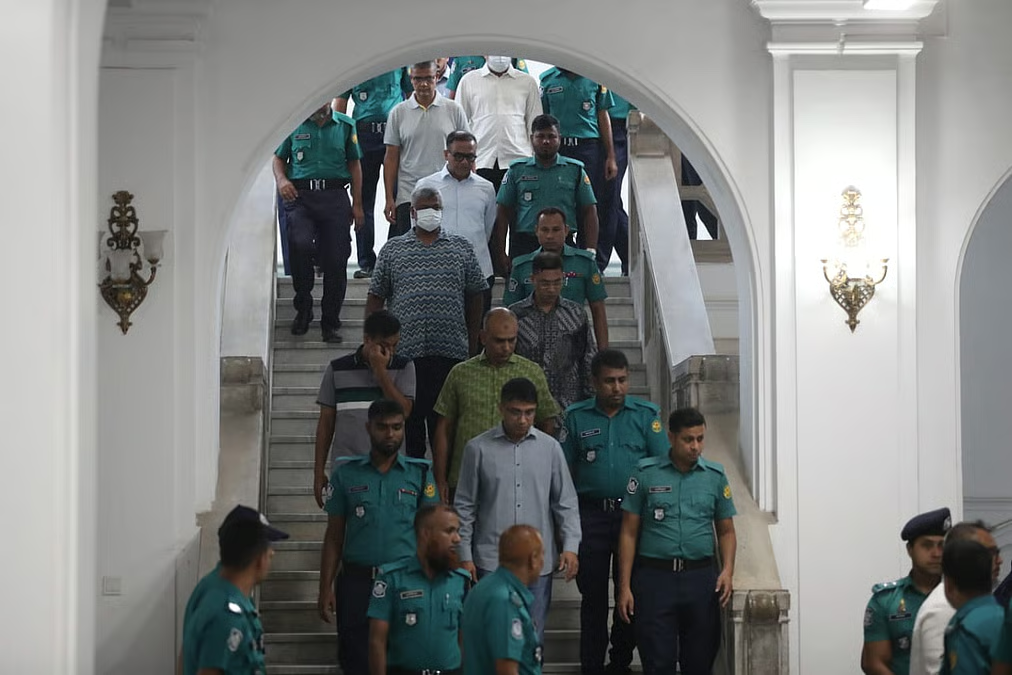
Detaining army officers for crimes under the previous regime
The ICT-1 charged at least 25 serving and retired military officers with significant crimes, including enforced disappearances and killings, alleged to have been committed during her government’s tenure.
In a parallel move, the Bangladesh Army took 15 serving officers under military custody pursuant to arrest warrants issued by the tribunal. In terms of volume and scope, this development therefore coincides with a crucial turning point in the country’s history of prosecuting state and security-force actors.
Cases and Context. In early October 2025, the ICT-1 issued arrest warrants against 25 or more military officers, serving and retired, related to three distinct cases—two of enforced disappearance and another of killings and crimes against humanity—related to the July–August 2024 protests that led to Hasina’s government’s ouster.
The 15 officers are all serving personnel, marking the first time in the history of Bangladesh that such a large number of active senior military officials are facing civilian trials.
The army’s own press statement indicates that, of the total list of 25, 9 are retired, one is on leave before retirement, and the rest – police – have been placed under “attachment order” along with one more who is serving but is to retire.
The charges Two of the cases involve enforced disappearance, secret detention, and torture involving fictitious structures, such as the army’s Joint Interrogation Cell and the paramilitary Rapid Action Battalion 4 (RAB), while the third involves killing and mass atrocities in the capital’s Rampura/Banasree region throughout the 2024 uprising. Notably, five generals are among the detained officers.
Why This Matters: Accountability of Security Forces – Bangladesh has a long-standing reputation for human rights abuses, including enforced disappearances, extrajudicial murders, and secret incarcerations, which are most often attributed to state agencies and intelligence or paramilitary forces. The event appears to send a message to expert circles that this will result in a high-ranking reporting military officer being tried in civilian court.
The UN High Commissioner for Human Rights termed it “a landmark move toward responsibility.” Civil-Military Relations – Bangladeshi Civil-Military Relationships Bangladesh-based U.S. troops themselves held serving officers in detention, which was not customary, as military operations were routinely protected from civilian judicial processes. 4 Some specialist sources believe this will test field morale ahead of the following general elections. Legal & Constitutional Implications – The amended legislation that now regulates the ICT solely blocks individuals who have been officially charged with contempt of office or convicted of military service operations. Active military personnel are not tried in a civil court.
Thus, it raises questions about the judicial system, civilian versus military law, and the right to a fair procedure. Political and Social Signal – The Nobel laureate Muhammad Yunus’s government in its post-change administration, has signalled its intent to address prior behaviour.
This also serves as a signal to the people of the victims of the desaparecidos that things could develop differently. However, other expert monoliths cautioned against overreaction or retaliation. Key Voices & Reactions Major General Mohammad Hakimuzzaman disclosed the official count of officers notified to show 16 and insisted that the law could not apply in its entirety against retirees.
Chief Prosecutor Mohammad Tajul Islam: Demands that the officers be brought to court and emphasises the tribunal’s direction to arrest and produce the accused.
UN Human Rights Chief Volker Türk: Welcomes the developments “as significant for victims and their families.”
Defence lawyers: While they deny the allegations, they repeatedly clarify that the officers understand that these proceedings will be a test of the Bangladesh government’s commitment to fair, transparent trials. Potential Outcomes & Long-Term Implications A successful prosecution explicitly strengthens the rule of law and signals impending, more far-reaching accountability for state actors.
Failure or the perception of selectivity undermines public confidence, particularly if it appears politically driven. Impact on military identity and morale: It will be a test of the Army’s willingness to cooperate and could shape future civil-military relations.
Victim redress and institutional reform: In addition to individual prosecutions, there will be immediate pressure for systemic reforms in intelligence, paramilitary oversight, and detention practices. International reputation: Bangladesh’s human rights credentials have seen significant improvement.
Challenges & Caveats: Due process, evidence and witness protection, Military cooperation, Political stability, and Perception of retroactive justice. What to Watch Next: The next hearing before ICT-1, scheduled for 22nd October 2025, is when the accused will be formally produced.
Is it possible to obtain the complete list of applications? Twenty-five army officers are released, and even if FG Kabir Ahmed is apprehended.
How the Army views the requirement for transferring officers beyond military discipline, and how the process is operated in actuality.
International human rights NGOs and allies simply respond when they notice procedural irregularities.
Reforms were declared by the interim government, but not claimed. Final Thoughts for Cinebuzz Times viewers, this episode, set in Bangladesh, is at the intersection of military, administrative, police, and Human Rights thriller elements.
Bangladesh Army’s Active and old personnel being accountable in civilian courts is a historic event. The treatment of these lawsuits in the civil rights court with openness, probity, and scope will test Bangladesh’s democratic and forensic dimensions.
Film producers, documentary makers, and social-issue reporters all provide a wealth of possibilities: the real human tragedy of banishing awful individual odysseys, military-level dynamic, conflict, and lawfare, and the many social punishments and community effects.
It’s a multi-dimensional backdrop worthy of the drama. I can also provide a companion essay with fewer words, highlighting the victims’ records and the human tragedy involved, or I could plan a deadline infographic with a history of the uprising and subsequent proceedings. Should I do that?