
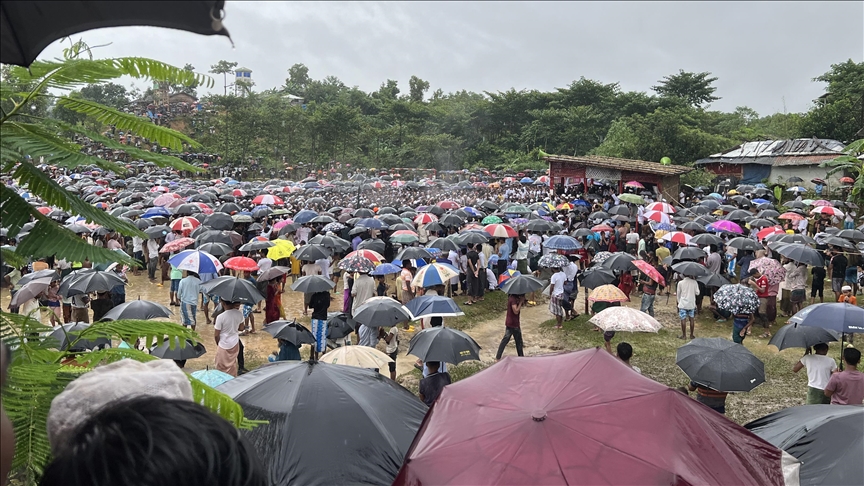
On 25 August 2025, tens of thousands of Rohingya refugees came together in the camps around Cox’s Bazar, Bangladesh, to mark ‘Rohingya Genocide Day’, a sombre commemoration of the mass atrocities they had left behind inside Myanmar eight years before. The biggest gathering was at the Kutupalong Modhur Chhara refugee camp in Ukhiya football ground, where 25,000-30,000 Rohingyas joined a rally to seek justice for what they said were atrocities committed against their ethnic minority people and spoke out for repatriation to their place of origin across the border in Myanmar’s Rakhine State.
A Day of Mourning and Protest
Since 2022, Rohingyas have been observing the 25th of August as ‘Genocide Day’ in commemoration of the (2017) military campaign that led to more than 700,000 Rohingya men, women, and children to seek refuge in Bangladesh. Survivors tell harrowing stories of large massacres, sexual violence, and the burning of their homes. This year’s events got underway at dawn with human chains, street rallies, and processions in some 15 camps spread over Ukhiya and Teknaf. By midmorning, crowds of men, women and children made their way to the Kutupalong rally ground; many wore headbands with slogans in Bengali or held placards demanding justice. Several, the paper said, carried pictures of relatives who Myanmar’s military had killed.
The crowd, the emotions were palpable. The event included prayers for the dead, while religious leaders called on the international community to increase pressure on Myanmar to facilitate peaceful and dignified returns to Rakhine.
Voices from the Community
Rohingya leaders spoke of their urgency and pain. Mohammad Zubair, a community leader, said the Rohingyas all want to go home, but that returning is risky because of the situation in Rakhine. “If repatriation is done only through the agreement between the Myanmar and Bangladesh governments, Rohingyas will face challenges from the Arakan Army,” he added. Kamal Hossain, another leader, invoked the atrocities of 2017 as he rallied the crowd: “The military shot and killed thousands of Rohingya men, women, and children. And our houses had been wrecked; even our women were dishonoured. Hundreds of others maimed by bullets now lead shattered lives in those camps. We want justice, we demand punishment for the guilty.” The leaders also reiterated that the Rohingyas desire the return of their land, security, and rights before any repatriation process begins. They are worried that, without stability in Rakhine, the cycle of violence will simply continue.
The Call for International Action
The rally highlighted both ongoing ICJ and ICC legal proceedings. Rohingya speakers urged that these cases be resolved quickly to provide accountability for the perpetrators of genocide. The Kutupalong rally ended before it was scheduled to, around 10:00 am, in line with a global conference on the Rohingya situation being held at Inani beach. Yet the community’s message was clear: Justice and repatriation are still urgent, unkept promises.
Authorities Respond
Genocide Day programs passed off peacefully, Refugee Relief and Repatriation Commissioner Md Mizanur Rahman said. He also accepted the Rohingyas’ demands for a sustainable and dignified repatriation to their homeland, as well as their demand for the pursuit of international judicial efforts. Now, over 1.4 million Rohingyas are staying in 33 camps in Ukhiya and Teknaf, Bangladesh. Of those, 124,000 came in the last 18 months, with many others unregistered. Despite years of talks and a series of agreements, not a single Rohingya has been returned to Myanmar since 2017.
A Community in Limbo
Eight years after fleeing one of the world’s most dire humanitarian crises of the 21st century, the Rohingya community finds itself trapped in a kind of sideways nowhere. Their lives are locked within barbed-wire camps, with little opportunity for work, schooling, or a future beyond the calculus of day-to-day sustenance. From the chants at Kutupalong on Genocide Day, one message boomed most loudly: The Rohingya want to go home — but not without justice, dignity, and security.