
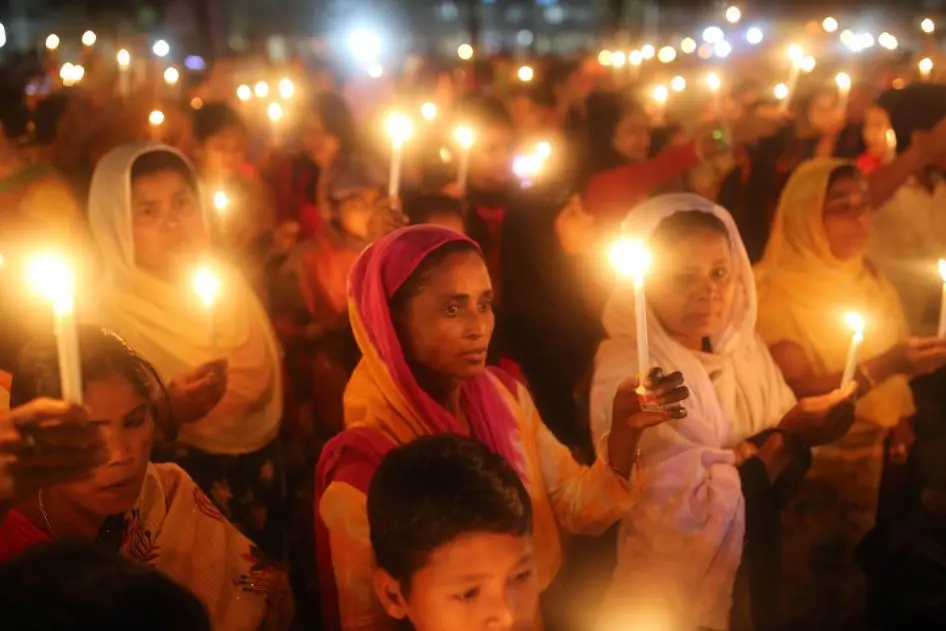
Why it’s rising, what it looks like, and what the data shows
Bangladesh’s founding promise was civic nationalism with space for religious diversity. Yet in recent years, religious intolerance (targeting minorities, “blasphemy” mob violence, pressure on atheists and secular voices) and violent extremism (militant recruitment, plots, and sporadic attacks) have both become more visible—often spiking during political transitions, periods of weak law-and-order, and viral misinformation cycles.
What the numbers suggest (and why they vary)
Measuring communal violence is difficult because many incidents go unreported, victims fear retaliation, and “religious” attacks are frequently entangled with local politics, land disputes, and criminality. Still, multiple reputable trackers point to a sustained problem:
- A Bangladeshi minority rights group, the Bangladesh Hindu Buddhist Christian Unity Council (BHBCUC), reported about 2,000 incidents of “communal violence” between 4–20 August 2024, including nine Hindu deaths and 69 attacks on places of worship, following the political upheaval that removed Sheikh Hasina. (Al Jazeera)
- The same Al Jazeera report cites Ain o Salish Kendra (ASK) as documenting 3,679 attacks on the Hindu community between January 2013 and September 2021 (vandalism, arson, and targeted violence). (Al Jazeera)
- Human Rights Watch notes that after Hasina’s resignation, attacks on Hindus, Ahmadi Muslims and ethnic minorities occurred amid broader reprisals, with violence that killed “over 200 people” and involved attacks on homes, shops, and places of worship. (Human Rights Watch)
- A Reuters-reported case in December 2025 shows how “blasphemy” allegations can still trigger lethal mob violence: Dipu Chandra Das, a Hindu man, was beaten and set on fire in Mymensingh; arrests followed. (Reuters)
These figures don’t all measure the same thing (incidents vs. deaths; specific minorities vs. broader unrest), but together they underline a pattern: minority-targeted violence increases when the state’s coercive capacity or political legitimacy is in flux.
Case studies: how intolerance and extremism manifest
Case study 1: Durga Puja violence (October 2021)
In October 2021, a wave of attacks during Durga Puja vandalised temples and minority neighbourhoods after a rumour spread around an alleged Qur’an desecration. The episode illustrated a recurring dynamic in Bangladesh: a triggering allegation + rapid online spread + delayed policing = mass targeting of minority spaces. (Wikipedia)
Case study 2: Post–August 2024 transition violence
After Sheikh Hasina’s exit in August 2024, BHBCUC’s reporting described countrywide incidents affecting minorities. Yet investigations cited by Al Jazeera also found that some deaths initially framed as purely religious were politically or personally motivated, highlighting the blurred line between communal hate and opportunistic violence in transition periods. (Al Jazeera)
Human Rights Watch similarly describes attackers as a mix of criminals and political actors, with minorities caught in the crossfire. (Human Rights Watch)
Case study 3: “Blasphemy” allegations and mob justice (December 2025)
The killing of Dipu Chandra Das in December 2025, reportedly triggered by allegations of blasphemy, reflects a wider regional phenomenon: informal “religious courts” by the crowd, where accusation alone can become a death sentence. Reuters’ account also shows the diplomatic blowback such incidents can provoke. (Reuters)
Case study 4: The militant threat after the big crackdowns
Bangladesh sharply reduced large-scale jihadist attacks after 2016 through aggressive counterterrorism, and the U.S. State Department’s terrorism reporting for 2023 noted no reported instances of transnational terrorist violence that year. (State Department)
But the threat has not disappeared; it has mutated. Analysts tracking newer formations—such as Jama ‘Atul Ansar Fil Hindal Sharqiyah (linked ideologically to al-Qaeda currents)—argue that arrests disrupted networks but did not erase recruitment pipelines, especially amid political instability. (jamestown.org)
A 2025 RSIS analysis likewise warns that early-2025 instability coincided with a rise in religious extremism and mob targeting of those deemed “un-Islamic.” (@RSIS_NTU)
What’s driving the rise?
- Political volatility and impunity: When institutions are polarised, violence becomes a tool—sometimes disguised as “religious outrage.” (Human Rights Watch)
- Misinformation and rapid mobilisation: Rumours around desecration, conversion, or insult spread fast and can overwhelm local policing (as seen in 2021). (Wikipedia)
- Local incentives: Land grabs, business rivalry, and revenge can hide behind communal slogans—making prosecution harder and deterrence weaker. (Al Jazeera)
- Ideological hardening: Even with fewer “spectacular” terror attacks, social enforcement—harassment of minorities, threats to secular voices—can widen the space for extremist narratives. (@RSIS_NTU)
What could help (practically)
- Fast, visible accountability: swift arrests, transparent trials, and victim compensation after attacks on worship sites and homes.
- Anti-rumour response systems: verified police messaging, local interfaith committees, and platform cooperation during flashpoints (festivals, elections).
- Community-based prevention: investment in local trust-building policing and early-intervention CVE programming (UN agencies are already training police on community strategies). (UNODC)
- Protect vulnerable speech: consistent protection for writers, activists, and minorities—so extremists cannot “set the limits” of public discourse.
Bangladesh has repeatedly shown it can push back against organised militant violence. The harder challenge now is preventing everyday intolerance—fuelled by misinformation and impunity—from normalising the conditions in which violent extremism can regenerate.