
Will Delhi extradite Sheikh Hasina?
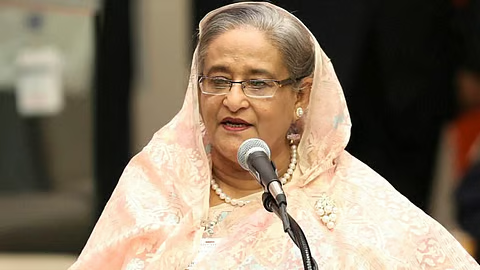
Bangladesh has once again approached India, requesting the extradition of former Prime Minister Sheikh Hasina in the wake of a dramatic verdict by the International Crimes Tribunal-1 (ICT). The move marks a renewed chapter in a tense diplomatic exchange that is drawing regional and international attention.
Foreign Affairs Adviser Md Touhid Hossain confirmed on Sunday that Dhaka had sent fresh diplomatic communication to New Delhi, though he declined to share further details. According to a diplomatic source in the Indian capital, a note verbale—a formal diplomatic note—was dispatched shortly after Dr Khalilur Rahman’s return, Bangladesh’s National Security Adviser and High Representative for the Rohingya Issue. Dr Khalilur had been in New Delhi to attend the 7th meeting of the Colombo Security Conclave (CSC) at the invitation of Indian NSA Ajit Doval.
The urgency of Dhaka’s renewed request follows Monday’s landmark ICT verdict, which sentenced Sheikh Hasina and former home minister Asaduzzaman Khan Kamal to death for crimes against humanity linked to last year’s July–August mass uprising. Former inspector general of police Chowdhury Abdullah Al-Mamun, who testified as a state witness, received a five-year sentence.
Immediately after the ruling, the Bangladesh government urged India to hand over Hasina and Kamal, both of whom were convicted in absentia.
“We will officially inform India of our position. Certainly, an official letter will be sent,” Foreign Affairs Adviser Hossain told reporters. He noted that while India had not previously responded to Bangladesh’s extradition request, “the situation is different now,” as the judicial process has concluded.
Bangladesh’s Ministry of Foreign Affairs stressed that India is obliged to act under the existing extradition treaty between the two countries.
“It would be a grave act of unfriendly conduct and a travesty of justice for any other country to grant shelter to these individuals convicted of crimes against humanity,” the ministry said in a strongly worded statement.
India, meanwhile, adopted a measured tone. Its Ministry of External Affairs stated that it had “noted” the ICT verdict and reiterated its commitment to the “peace, democracy, inclusion and stability” of Bangladesh. New Delhi emphasised that it would continue engaging “constructively with all stakeholders,” without directly addressing the extradition request.
Security experts in Bangladesh argue that India has clear legal and moral obligations. Maj. Gen. (Retd.) ANM Muniruzzaman, President of the Bangladesh Institute of Peace and Security Studies (BIPSS), stated that a friendly neighbour should respect Bangladesh’s judicial process.
“Hasina’s trial has gone through all international standards and legal systems,” he said at the Bay of Bengal Conversation in Dhaka. “If India respects international norms and rules, then India should respect Bangladesh’s legal system.”
Muniruzzaman highlighted the reciprocity embedded in the extradition treaty:
“What would India’s reaction be if Bangladesh were sheltering convicted Indian citizens and refused to return them? By all accounts, India is legally bound to send Hasina back.”
As the diplomatic pulse quickens, all eyes are on New Delhi’s next move. Dhaka has made its position unmistakably clear. Now, the region waits to see how India navigates the intersection of law, diplomacy, and geopolitical strategy.