
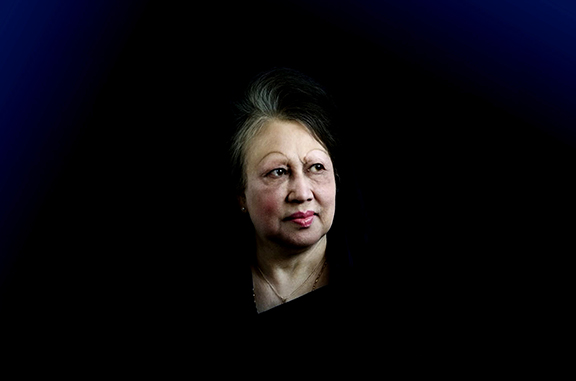
Bangladesh came to a standstill as millions of its people came out to say a final goodbye to Khaleda Zia, one of the country’s most consequential political figures.
Tears, prayers and respectful silence descended on Manik Mia Avenue and its vicinity as the former prime minister was laid to rest with state honour, with men in uniform saluting the national leader at her final resting place amid a heavy presence of military personnel who gave a sombre farewell firing.
From early morning, Dhaka became an expanse of mourners. They streamed in from all over India — by bus, train, launch and even metro rail, driven by a collective sense of grief.
Battling winter cold, people spent the night outdoors to gain a spot near the funeral venue, clutching national flags, party banners, and portraits of the leader they called the “guardian of democracy.”
Never before had such a mass of men assembled. Farmers, students, teachers, government workers, and political activists openly wept and spoke of Khaleda Zia as a symbol of resistance and resilience. For many, she came to symbolise the lengthy struggle for the return of parliamentary democracy in Bangladesh.
Her namaz-e-janaza was held at Manik Mia Avenue in the afternoon, with the Khatib of the Baitul Mukarram National Mosque leading. As the coffin, draped in the national flag, was brought forward by state tax, responsive silence, and tea bearers to thunderous applause.
Her elder son, BNP Acting Chairperson Tarique Rahman, called upon the countrymen to pray for his mother, choking with tears as he sought peace for the departed soul in heaven from Allah.
Khaleda Zia was later buried at Zia Udyan next to her husband, Ziaur Rahman, a former president and hero of the liberation war. A guard of honour from the Army, Navy, and Air Force fired a three-gun salute, as “Last Post” echoed across the grounds.
Messages were reportedly laid in the form of floral wreaths on behalf of both the President and the Chief Adviser, as well as Pakistan’s military leaders and political chiefs. Doa and munajat were recited to conclude the burial process, which ended shortly before sunset.
The farewell was both national and international. Politicians from across the region and beyond attended the ceremony to pay tribute to Khaleda Zia, reflecting her standing on a regional scale. Their appearance transformed the funeral into a moment of diplomatic grief, shared as an indication that she commanded respect beyond the borders of Bangladesh.
Khaleda Zia, 80, breathed her last at the Evercare Hospital in Dhaka, being treated for Covid-19. The country’s first female prime minister, she won a historic popular mandate in 1991. She led the nation back to parliamentary democracy, playing a central part in establishing the caretaker government system for elections.
Her political career altered the course of modern Bangladeshi politics, changing from reluctant entrant after her husband was assassinated to “an uncompromising leader” who fought autocracy.
The interim government also announced three days of state mourning, with flags to fly at half-staff across the country and abroad. The BNP declared seven days of party mourning and set up condolence books across the country.
1:08 Listen as Bangladesh mourns; Khaleda Zia leaves a legacy of struggle, scandal, and strength. Read more. In the weeping of millions and the quiet mourning of a nation, her place in history is firm and solid.