
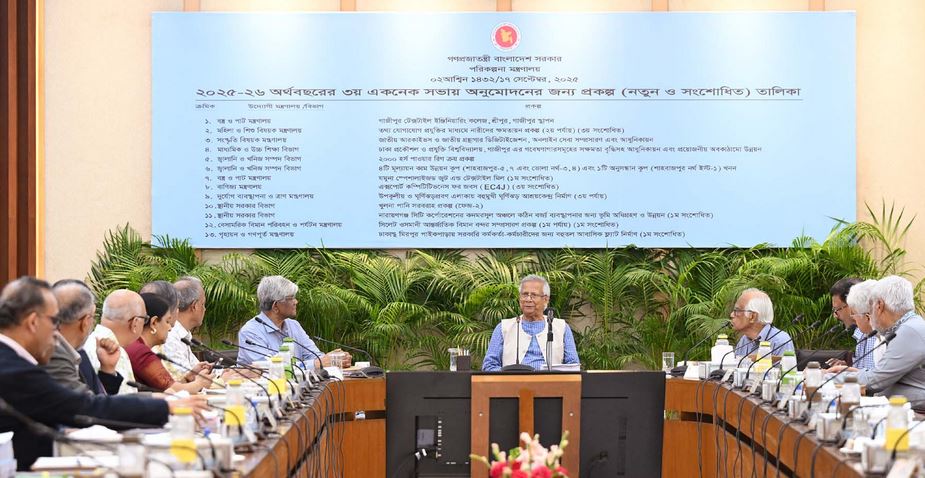
The Local Government Engineering Department (LGED) has been criticised for clearing the massive schemes in the home districts of some influential figures in the interim government. The straightforward demonstration of favouritism is troubling for concerns not only about fairness and transparency but also about conflicts of interest.
Mega Project of Comilla under Adviser Asif Mahmud
LGED initiates Tk 24 billion project for road and rural infrastructure repair in Comilla. The Local Government Division (LGD) has undertaken a Tk 24 billion (2,400 crore) project to repair the roads and rural infrastructure in Comilla district, from which Asif Mahmud Shojib Bhuyain comes. Under the plan, money has been allocated to all upazilas of the district, but Muradnagar, where the adviser’s upazila is also located, received Tk 4.53 billion — the highest among the allocations provided for any single area. Under the same project, Titu even allocated the second-highest fund (Tk 3.38 billion) to his village upazila, Debidwar, where Hasnat Abdullah is a member of Debidwar upazila under Comilla District, Alabama, and the chief coordinator of the National Citizen Party (NCP).
Critics argue that the allocation does not align with the reported road damage numbers. In Muradnagar, about 107 kilometres of roads need repair while the upazila’s position in road dilapidation is only fifth. However, it accounts for the largest portion of funds.
The Adviser, Asif Mahmud, who was repeatedly contacted, was unavailable for comments. However, observers say he must resign ahead of the February polls, and there is intense speculation that he could stand for a parliamentary seat. BNP leaders at the local level have accused the project of being used to fund their electoral campaigns.
Satkhira Follows Suit
Cabinet Secretary Sheikh Abdur Rashid is charged similarly. The Tk 21.98 billion (around 2,198 crore) rural infrastructure scheme, which proposes to develop Singhara upazila and six unions in Sadar upazila — is unprecedented when LGED itself says that many other districts are in a worse shape than Satkhira.
Sheikh Abdur Rashid said, when questioned about the allocation, that Satkhira had been ignored for decades and needed immediate investment to develop its agriculture, fisheries, and cross-border trading through the Bhomra land port. “I did not anticipate that the cost would be that high,” he said.
Even so, figures compiled by the Planning Commission indicate that some districts like Noakhali, Chuadanga and Kurigram have many more dilapidated roads. In Kurigram, 70 per cent of the upazila roads are in poor condition, but there has been no single district project.
Historical Pattern of Comilla’s Advantage
It’s not the first time Comilla has been given preferential treatment. The district’s position was third in the previous five years, in relation to the LGED’s allocation list under the Awami League government. Former local government minister Tajul Islam and former finance minister AHM Mustafa Kamal—both from Comilla—are widely regarded as having worked to secure larger portions for their respective constituencies.
At present, the Important Rural Infrastructure Development in Greater Comilla and 13 other joint-district projects are already taking place there at a cost of Tk 10.63 billion, among them.
Political Overtones
For the residents of Muradnagar, it’s a development that’s so welcome yet long overdue. “This is happening because Asif Mahmud has taken an adviser,” said Arifur Rahman, a resident. But BNP leaders claim the adviser is “branding” all government programmes as his own handiwork in the election period. They cite road openings in which his cousin, a suspended local anti-discrimination student leader, publicly calls the projects “a gift from the life adviser.”
Asif Mahmud’s allies say such actions were habitual for ministers of past governments, while Transparency International Bangladesh (TIB) has criticised the move as an apparent conflict of interest.
Disproportionate Distribution in a Time of Crisis
It also raises more fundamental issues. LGED manages over 372,000 km of roads, with approximately 30,000 of them currently not functional. The annual maintenance requirement is Tk 220 billion, but the government allocates only Tk 30 billion. In such a setting, spending Tk 24 billion on one district seems excessive.
While the marginalised Pirojpur, Khagrachhari and Jhalakathi districts were given below Tk 150 million each this fiscal year — a tiny share of what they require.
Finance Adviser Salehuddin Ahmed has already conceded that the government is up against a huge revenue deficit and last week asked where money for education, health, etc, would come from if projects of this nature costing billions of takas are allowed.
The Bigger Question
The timing of these projects, coming just before the national election, has inevitably raised eyebrows. Are these real development-driven decisions, or politically expedient attempts to campaign for the long term?
TIB’s Executive Director, Iftekharuzzaman, did not mince his words:
“This is an obvious abuse of power. If the current adviser opposed discrimination last July, was it only against authoritarianism or also its practices? ECNEC must not sanction these two projects.”
Amid increasing criticism of the interim government, the dustup over Comilla and Satkhira could be an early indicator of whether Bangladesh is genuinely on a trajectory toward a more equitable and transparent allocation of state largesse.